


Medición de temperatura y humedad de la madera
Wood moisture meters are necessary because the relative humidity (RH) around wood is always changing, and so is the wood’s moisture content (MC).
La madera absorbe la humedad de su entorno cuando la HR aumenta, y cuando la HR disminuye, la madera libera humedad.
Temperature works differently. Air temperature has a much smaller direct effect on wood’s MC than RH does, but the temperature of the wood itself affects pin meter readings, so a pin meter reading is only as good as its correction for wood temperature.
Humedad relativa
Lumber producers use kiln control systems to lower the MC of freshly cut (green) lumber. Ideally, they dry it to the MC it will be at in use, its equilibrium moisture content (EMC) for that environment.
As any weather watcher knows, the RH of the air is always changing, and wood’s MC changes with it.
La madera no suele contraerse ni hincharse con el uso, salvo si su contenido de humedad (CH) varía de alguna manera. El CH de la madera cambia cuando cambia la humedad relativa (HR).
Unfortunately, if the wood was at the wrong MC when it was put into use, it will move toward its EMC and may shrink or swell quite a bit in the process.
Cuando considere cambios en la CM, piense en cambios en la HR.
Temperatura
Temperature alone doesn’t cause any significant size changes in wood, although heat does make moisture changes happen faster. The bigger effect is that when air is heated, its RH drops unless moisture is added.
For example, if it’s 30°F outside with 100% RH (snowing), the EMC is about 28%.
If that outside air is brought into a home and heated, you’ll see these RH and EMC values (EMC values per the USDA Forest Service Manual de madera):
- Heated to 40°F: about 68% RH and 13% EMC
- Heated to 50°F: about 47% RH and 9% EMC
- Heated to 60°F: about 34% RH and 7% EMC
- Heated to 70°F: about 24% RH and 5% EMC
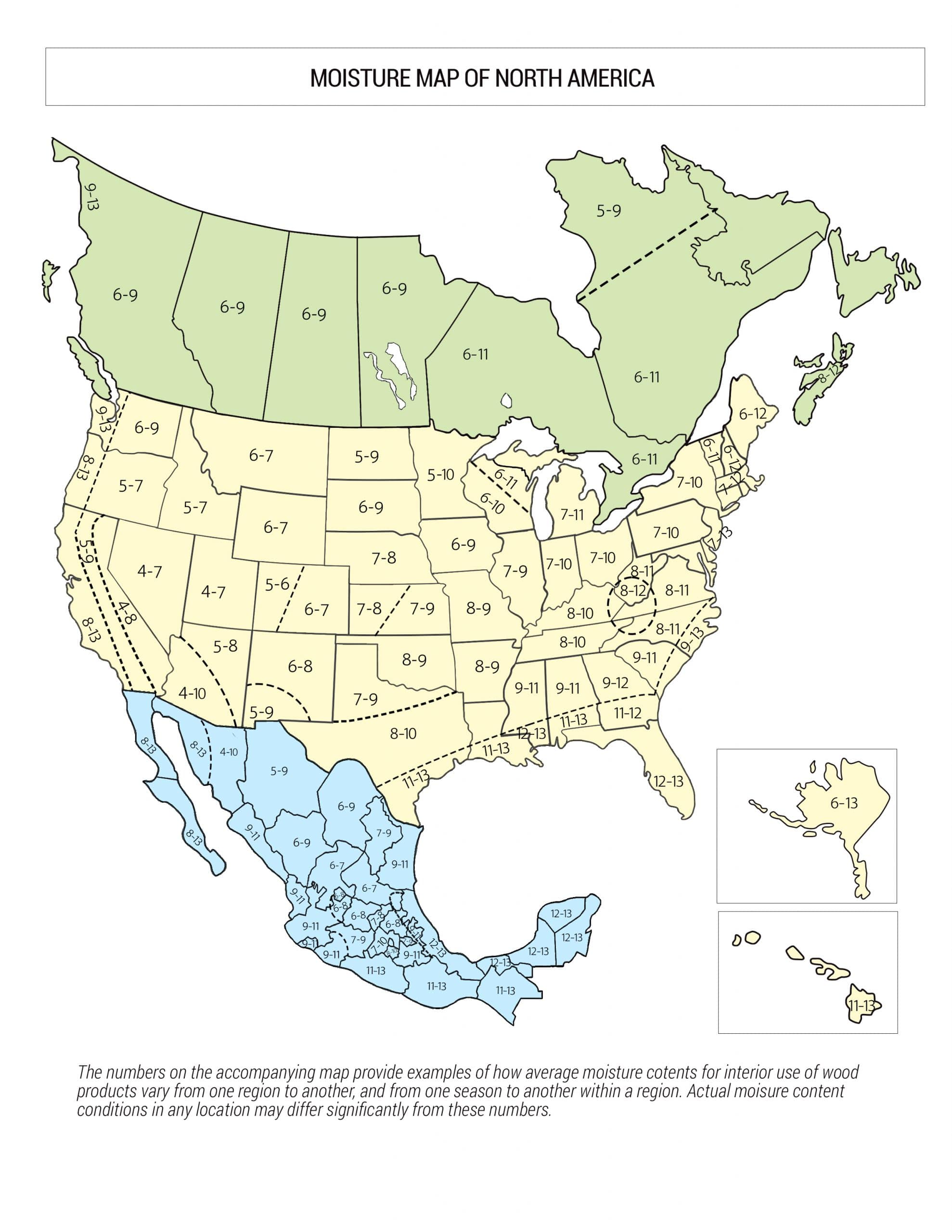
In much of North America, heated homes and offices run at roughly 6% EMC in winter and 9% EMC in summer.
Heating doesn’t remove moisture from the air, but it lowers the air’s RH. Without added humidity, the wood’s EMC drops, and the wood dries.
Para mantener la EMC de la madera en equilibrio durante los meses de invierno, los propietarios pueden agregar humedad al aire instalando un humidificador en el horno, por ejemplo.
So while EMC changes can line up with rising temperatures, most of the change comes from the drop in RH that heating causes. Ambient temperature on its own has only a minor direct effect compared with RH.
¿Pero qué pasa con la temperatura de la propia madera?
Obtenga más información sobre temperature’s impact on wood moisture content en nuestra guía

Descarga gratuita: 6 razones por las que tu proyecto de madera fracasó

Lecturas del medidor de humedad
A pin-style wood moisture meter’s readings must be corrected when the wood is warmer or cooler than about 70°F, so the MC readings stay accurate as the wood temperature varies.
Wagner Meters makes pinless handheld wood moisture meters that don’t need adjustments for most wood temperatures. Even frozen wood with an MC below 15% can be measured with minimal temperature concerns. (Call Wagner Meters before measuring frozen wood that may have a higher MC.)
Si está planificando un proyecto de construcción o renovación, lea también sobre contenido de humedad en los montantes de madera.
Compre medidores de humedad Orion

Larry Loffer es técnico superior en Wagner Meters, donde cuenta con más de 30 años de experiencia en la medición de la humedad de la madera. Licenciado en Sistemas Informáticos, Larry participa en el desarrollo de hardware y software para soluciones de medición de la humedad de la madera.
Última actualización el 9 de octubre de 2026

 800-634-9961


Tenemos un horno de secado de madera casero. Necesito un método para medir la humedad relativa y la temperatura dentro del horno. Estoy abierto a sugerencias de productos.
Gracias,
Entrenador (Coach)
David
Tengo un par de preguntas:
1. ¿Cuál es la temperatura más alta del entorno del horno?
2. ¿Quieres algo que te pueda dar la información de HR y temperatura en el exterior del horno, para no tener que abrirlo?
¿Podría recomendarme un estudio significativo sobre la madera en el campo de la física? Lo necesito urgentemente, señor.
Hola Apolo,
Dado que la madera es un material de construcción común, existen numerosos estudios que analizan sus propiedades de resistencia física. Estas pueden ser la resistencia al corte y a la flexión. A continuación, un ejemplo:
http://workshopcompanion.com/KnowHow/Design/Nature_of_Wood/3_Wood_Strength/3_Wood_Strength.htm
Deberías poder encontrar muchos artículos sobre fuerza, con fórmulas, en Internet.
Quiero poner epoxi en abeto Douglas y dice que la temperatura de la madera tiene que ser de 77 grados. ¿Fabricas un medidor o cómo puedo verificar la temperatura de la madera?
Hola Tim,
Sí, aquí hay un enlace a nuestro termómetro infrarrojo.
Simplemente apúntelo hacia la madera para obtener la temperatura.
https://www.wagnermeters.com/shop/infrared-thermometer/
Gracias